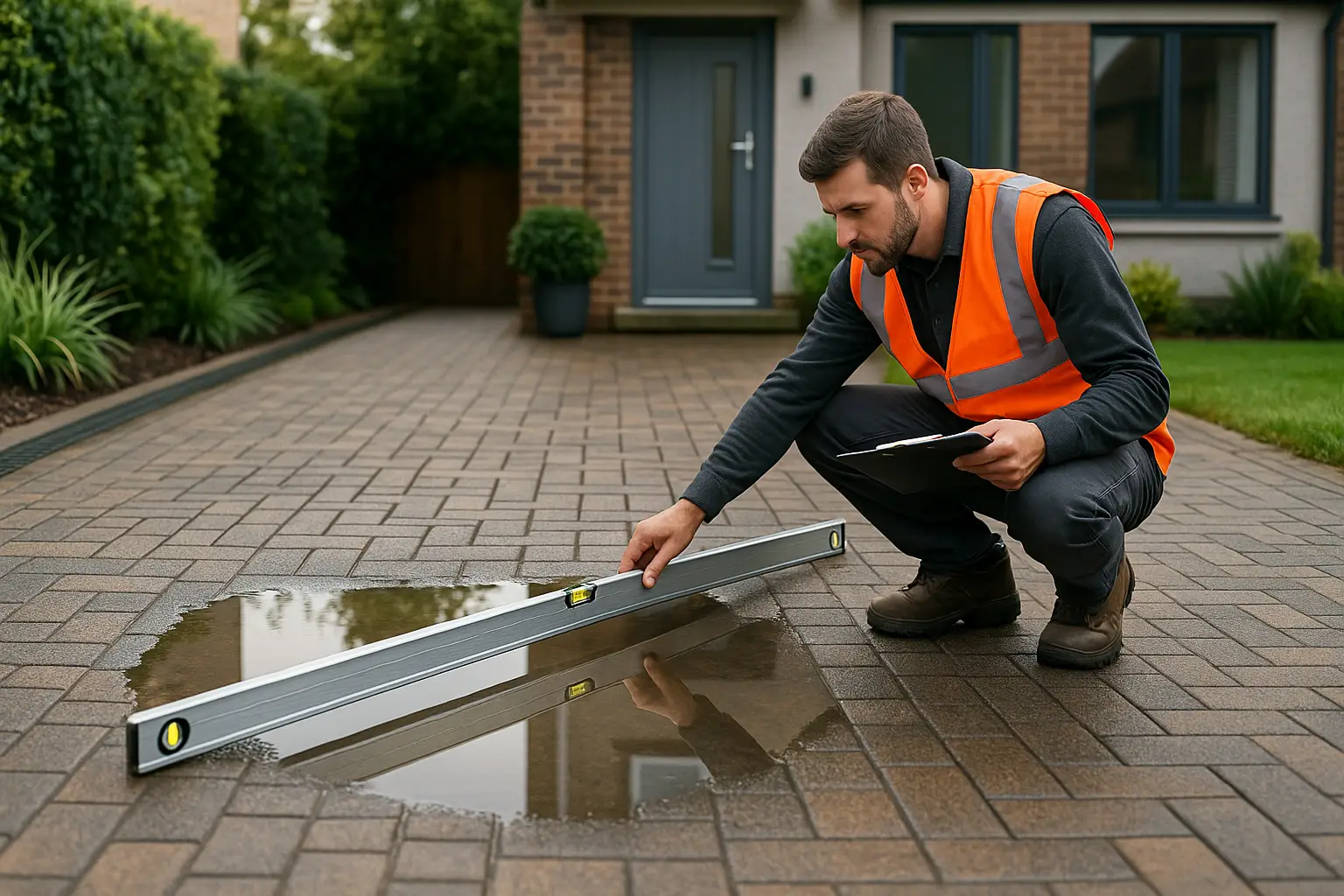
When a driveway starts to dip or feel uneven, it is not just the surface wearing out. The layers under the surface are moving. Your paving, resin, concrete or tarmac is only the skin. The strength comes from the soil underneath, the thick stone layer called the sub-base, and the bedding on top of that. If any of those layers were too thin, not compacted properly, or get washed out by water, the top will sink. Small dips turn into puddles. Puddles weaken joints. Over time you get bigger low spots and trip hazards.
Common Reasons
- Not enough sub-base. A strong drive needs a good depth of compacted stone. If the installer cut corners, the stone settles later and the surface follows.
- Soft ground. Topsoil left behind, made-up ground, clay that swells and shrinks, or old roots that rot away can all cause settlement.
- Water problems. Leaking downpipes, blocked channels, or falls that send water toward the house wash fine material out of the base. The support disappears and a hollow forms.
- Utility trenches. Gas, water or fibre laid after the drive was built can leave a long straight dip if the trench backfill was not compacted in layers.
- Heavy point loads. Skips, scaffold legs or parking in the same place every day can press the base down.
- Loose edges. Kerbs without proper concrete haunching let the structure spread. Once the edge moves, the middle starts to sink.
Check what you have
Stand back and look at the pattern. A straight, ruler-like dip often means a trench. A bowl near the pavement may be traffic. A dip near the front door usually points to drainage. After rain, watch where water comes from and where it sits. If it is safe to do so, lift a few blocks at the lowest point or have a small core taken in resin or tarmac. Look at the bedding thickness and the condition of the stone below. Also check the edges. Cracked haunching or gaps along the kerbs are strong clues the base is moving.
Recommended Fix
- Block paving. For a local dip, lift the blocks in that area, remove soft bedding, compact the sub-base in thin layers and add more stone if needed. Lay fresh sharp sand at an even depth, replace the blocks tightly, compact and re-sand the joints. If the dip runs along a trench, open the whole line, rebuild the base properly, then relay.
- Resin, tarmac or imprinted concrete. These cannot be spot-lifted like blocks. Cut out a neat rectangle around the sunken area, rebuild the base underneath, then relay the surface. Do not skim over a hollow. It will fail again.
- Edges. Re-set loose kerbs with proper concrete haunching on both sides before you rebuild the middle.
- Drainage. Clear channels, fix leaking downpipes, and add a slim linear drain at door thresholds. Set a gentle crossfall so water runs to the inlets.
How we build a drive that stays level
We begin with a careful survey. We check levels, soil condition and where the water goes. We remove soft spots and separate poor ground with a geotextile if needed. On clay or made-up ground we may add a geogrid to lock the stone. We install a deep sub-base, usually 150 to 250 mm for cars, compacted in thin layers. We set strong edges, then build gentle falls away from the house, normally 1:80 to 1:60, and add linear drains at thresholds. For the finish we choose what suits your home and loading: herringbone block paving for strong interlock, correctly specified resin bound over a solid base for a seamless look, or fibre-reinforced concrete with a grippy texture.
The Takeaway
A sinking driveway is not only a look issue. It can damage tyres, create trip risks and push water toward your home. Pooling at the threshold can lead to damp and failed seals. Putting levels, edges and drainage back into shape protects your kerb appeal and the fabric of the house.
If your drive is dipping, we will check the cause, explain your options and give you a clear plan. Sometimes a focused lift-and-relay is perfect. Sometimes a full rebuild is the honest fix. Either way you get straight answers, a tidy job and a surface that stays where it should because the layers beneath are right.